Molecular Pharmacology
About
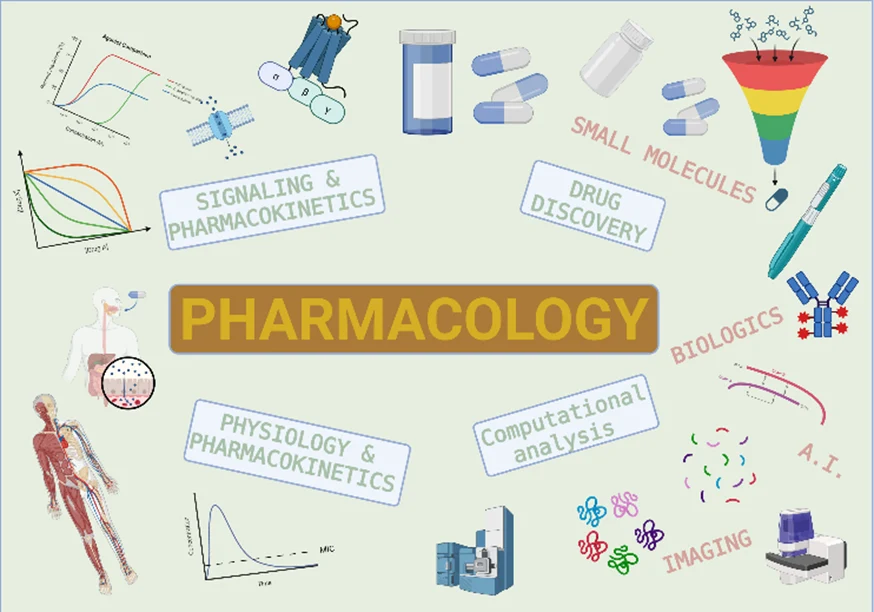
Pharmacology, which is the most translational of the biological sciences, focuses on mechanisms whereby drugs and toxins perturb biological processes. It draws on all basic science fields to investigate how drug targets regulate normal physiological mechanisms and contribute to disease pathophysiology.
Pharmacologists work to identify and validate drug targets with the ultimate goal of intervening — with rational and effective drug therapy — in signaling cascades and metabolic pathways that have gone awry. Such intervention requires understanding of the major organismal control systems and identifying defects in the systems that occur with disease. For example, revolutionary new drug therapies targeting the incretin/GLP system in diabetes are also effective in reducing obesity, a major risk factor for many diseases, and are a recent example of the translation of basic research to the discovery of an effective drug therapy.
The Pharmacological Sciences Training Program at UVA encompasses the breadth of this discipline and provides students with a solid foundation for careers in Pharmacology. The diverse expertise of the Pharmacology faculty provides training opportunities that encompass molecular and cellular biology in the context of whole animal physiology, drug discovery and translational medicine. Technologic advances in AI, imaging, and -omics approaches have accelerated the process of identifying potential drug targets and are expected to improve the success rate of drug discovery and development. Experience and practical training with these cutting-edge tools and an underlying knowledge of organismal physiology can equip students with the skills necessary to contribute effectively to biotechnology and drug discovery research in the future. Students are supported by the Pharmacological Sciences Training Grant, now in its 49th year. Visit our Pharmacology page to learn more.
Faculty
Mechanisms of neuromodulation in central neurons
Douglas A. Bayliss
Mechanisms of neuromodulation in central neurons

Molecular mechanisms linking innate immune and insulin signaling to control cell growth and metabolism
Michelle Bland
Molecular mechanisms linking innate immune and insulin signaling to control cell growth and metabolism

Drug Development Targeting Transcription Drivers in Cancer; Structure/Function Studies of Transcription Factor Drivers in Cancer
John H. Bushweller
Drug Development Targeting Transcription Drivers in Cancer; Structure/Function Studies of Transcription Factor Drivers in Cancer

Hematology and Oncology, Cell Biology, Lipid Signaling, Cancer Cell Signaling, and RNA Biology
Charles Edward Chalfant
Hematology and Oncology, Cell Biology, Lipid Signaling, Cancer Cell Signaling, and RNA Biology

Immuno-Oncology, T cell therapy, TCR Discovery, Next generation cell therapy
Danielle R. Cook
Immuno-Oncology, T cell therapy, TCR Discovery, Next generation cell therapy

Neuron-glia and glial-glial interactions
Jaeda Coutinho-Budd
Neuron-glia and glial-glial interactions

Ion channels and Ca2+-signaling in inflammation, immunity and tissue homeostasis
Bimal N. Desai
Ion channels and Ca2+-signaling in inflammation, immunity and tissue homeostasis

Uncovering the molecular etiology of neurodegenerative diseases
Nikolay V Dokholyan
Uncovering the molecular etiology of neurodegenerative diseases

Systems Immunology, Cancer Systems Biology, , Neonatal and Maternal Immunology
Sepideh Dolatshahi
Systems Immunology, Cancer Systems Biology, , Neonatal and Maternal Immunology

Structure and Function of Macromolecular Complexes Using Electron Microscopy
Edward H. Egelman
Structure and Function of Macromolecular Complexes Using Electron Microscopy

Brain metabolism, cognitive decline, cholesterol and Alzheimer's disease
Heather Ferris
Brain metabolism, cognitive decline, cholesterol and Alzheimer's disease

Novel Therapies for Treating and Preventing Ischemic Heart Disease
Brent A. French
Novel Therapies for Treating and Preventing Ischemic Heart Disease

Molecular mechanisms controlling insulin signaling and fat synthesis.
Thurl E Harris, PhD
Molecular mechanisms controlling insulin signaling and fat synthesis.

Translating our discoveries in the microcirculation to tangible benefits in patients.
Brant Isakson
Translating our discoveries in the microcirculation to tangible benefits in patients.

The Pathophysiology of neurodegenerative diseases, including Alzheimer’s disease (AD), Parkinson’s disease (PD) and other dementia-related disorders.
Lulu Jiang
The Pathophysiology of neurodegenerative diseases, including Alzheimer’s disease (AD), Parkinson’s disease (PD) and other dementia-related disorders.


Seizures, neuronal excitability and plasticity
Jaideep Kapur
Seizures, neuronal excitability and plasticity

Metabolic and Genetic Regulation of Aging, Redox Biology, DNA Repair, Comparative and Functional Genomics, Stress Resistance, Drug Discovery, Evolutionary Biology, Synthetic and Systems Biology for Evolutionary Engineering, Adaptive Evolution, Mitochondrial Signaling, Neurodegenerative Diseases
Alaattin Kaya
Metabolic and Genetic Regulation of Aging, Redox Biology, DNA Repair, Comparative and Functional Genomics, Stress Resistance, Drug Discovery, Evolutionary Biology, Synthetic and Systems Biology for Evolutionary Engineering, Adaptive Evolution, Mitochondrial Signaling, Neurodegenerative Diseases

Advancement in the design of imaging agents; molecular imaging and radiological sciences.
Kimberly Kelly
Advancement in the design of imaging agents; molecular imaging and radiological sciences.

Role of lipid oxidation products in inflammation and vascular immunology in atherosclerosis and diabetes
Norbert Leitinger
Role of lipid oxidation products in inflammation and vascular immunology in atherosclerosis and diabetes

Chemical biology of sphingosine 1-phosphate
Kevin R. Lynch
Chemical biology of sphingosine 1-phosphate


Identifying tumor selective drug targets, Understanding the genetic drivers of tumor immune evasion
Timothy D Martin
Identifying tumor selective drug targets, Understanding the genetic drivers of tumor immune evasion

Genetic variation, Complex diseases, Coronary artery disease, Genomics, Epigenomics, Regulatory mechanisms, Vascular biology, Pharmacology and Physiology
Clint L. Miller
Genetic variation, Complex diseases, Coronary artery disease, Genomics, Epigenomics, Regulatory mechanisms, Vascular biology, Pharmacology and Physiology

Cell signaling, stem cell biology, molecular and epigenetic mechanisms of blood and breast cancers
Golam Mohi
Cell signaling, stem cell biology, molecular and epigenetic mechanisms of blood and breast cancers

Understanding the neural code underlying motivated behaviors like feeding, drinking, and social interaction, with a focus on how malfunction in associated brain areas are involved in diseases like addiction and eating disorders
Edward Horng-An Nieh
Understanding the neural code underlying motivated behaviors like feeding, drinking, and social interaction, with a focus on how malfunction in associated brain areas are involved in diseases like addiction and eating disorders

Understanding the cellular mechanisms by which seizures are initiated in SCN8A epileptic encephalopathy (DEE13) and temporal lobe epilepsy. My lab uses a number of experimental techniques including patch clamp electrophysiology and in vivo seizure monitor
Manoj Patel
Understanding the cellular mechanisms by which seizures are initiated in SCN8A epileptic encephalopathy (DEE13) and temporal lobe epilepsy. My lab uses a number of experimental techniques including patch clamp electrophysiology and in vivo seizure monitor

Exploring epilepsy circuits then preventing seizures using gene therapies. Developing drug-inducible genetic switches for insulin replacement gene therapies.
Edward Perez-Reyes
Exploring epilepsy circuits then preventing seizures using gene therapies. Developing drug-inducible genetic switches for insulin replacement gene therapies.

Bioanalytical tools for inflammatory disease
Rebecca Pompano
Bioanalytical tools for inflammatory disease

Roles of complex signaling networks involved in the regulation of cardiovascular function and disease
Jeffrey J. Saucerman
Roles of complex signaling networks involved in the regulation of cardiovascular function and disease

Regulation of transcription by nuclear hormone receptors, transcriptional control of metabolism and inflammation, small molecule approaches to drug discovery
Ira G. Schulman
Regulation of transcription by nuclear hormone receptors, transcriptional control of metabolism and inflammation, small molecule approaches to drug discovery

Role of endoplasmic reticulum-associated protein degradation in health and disease
Shengyi Iris Sun
Role of endoplasmic reticulum-associated protein degradation in health and disease


Understanding Protein and RNA regulations of gene expression via chromatin structure in myeloid cell development and diseases
Bon Q Trinh
Understanding Protein and RNA regulations of gene expression via chromatin structure in myeloid cell development and diseases

Membrane-transport physiology and biophysics
Ming-Feng Tsai
Membrane-transport physiology and biophysics

Analytical Neurochemistry; Dopamine and Serotonin Neurotransmission in Drosophila; Mechanisms of rapid adenosine signaling in rodents
B. Jill Venton
Analytical Neurochemistry; Dopamine and Serotonin Neurotransmission in Drosophila; Mechanisms of rapid adenosine signaling in rodents

Iron metabolism and Immunometabolism in inflammation and autoimmune diseases
Kelsey Voss
Iron metabolism and Immunometabolism in inflammation and autoimmune diseases

Neural control of cardiorespiratory function in health and disease
Ian C Wenker
Neural control of cardiorespiratory function in health and disease

Researching fundamental roles of the epigenome in control of the context-specific transcriptional programs.
Kexin Xu
Researching fundamental roles of the epigenome in control of the context-specific transcriptional programs.

Structural biology, Cryo-EM, Mitochondrial stress, Integrated stress response, De novo protein design, Drug development, Neurodegeneration, Heart disease, Cancer
Jie Yang
Structural biology, Cryo-EM, Mitochondrial stress, Integrated stress response, De novo protein design, Drug development, Neurodegeneration, Heart disease, Cancer

Integrating high-throughput proteomic, chemical, genetic and computational tools for target identification and drug discovery in cancer biology
Tian Zhang
Integrating high-throughput proteomic, chemical, genetic and computational tools for target identification and drug discovery in cancer biology
