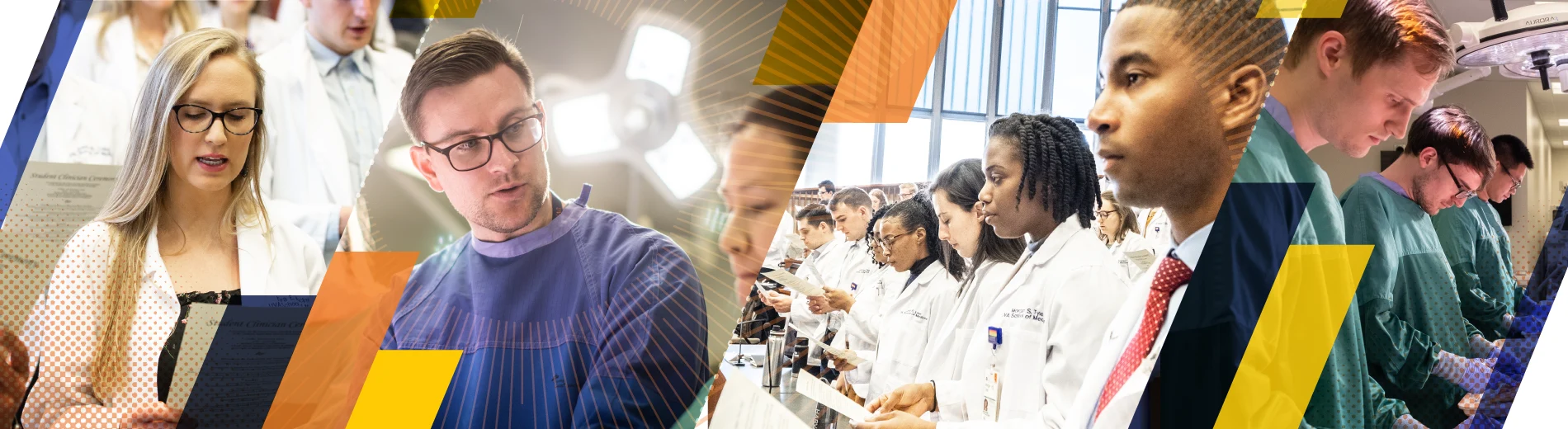
Students at the University of Virginia School of Medicine are engaged and challenged from the first day on Grounds. Our innovative Cells to Society curriculum, provides a comprehensive approach that integrates medical science and practice to teach foundational science in the context of how it is used by physicians in their clinical practice and provides learning experiences across a broad variety of clinical specialties and settings.
This model emphasizes collaborative team and individual learning, student-faculty interactions, clinical skills education and clinical problem-solving, hands-on laboratories, hospital and community-based patient care and opportunities to individualize learning. The UVA Cells to Society curriculum will prepare students to provide excellent patient-centered care, practice evidence-based medicine, and engage in lifelong learning.
UVA School of Medicine's 12 Educational Program Objectives<a href="#" id="ProgramObjectives"></a>
Each phase of our curriculum is designed to build clinical and interpersonal skills. By the time students graduate, they will possess the competencies necessary to become a contemporary physician as defined by the UVA School of Medicine education program objectives. These Educational Program Objectives include:
Demonstrate in practice a set of personal and professional attributes that enable independent performance of the responsibilities of a physician and adaptation to the evolving practice of medicine.
Attributes include:
Humanism, compassion and empathy.
Commitment to collegiality and interdisciplinary collaboration.
Engagement in continuing and lifelong self-education.
Awareness of a personal response to one’s personal and professional limits.
Engagement in community and social service.
Commitment to high ethical standards for personal and professional conduct.
Knowledge of legal standards and commitment to legal conduct.
Awareness of economic issues in clinical practice.
Cultural competency and responsiveness in clinical practice and professional relationships.
The analysis and further expansion of medical knowledge and understanding.
Engage and communicate with a patient, develop a student-patient relationship, and communicate with others in the professional setting, using interpersonal skills to build relationships for the purpose of information gathering, guidance, education, support, collaboration and the provision of individualized patient care.
Take a clinical history, both focused and comprehensive.
Perform a mental and physical examination.
Select, justify and interpret selected clinical tests and imaging.
Explain the rationale for and be able to perform a variety of basic clinical procedures.
Record, present, research, analyze and manage clinical information.
Diagnose and explain clinical problems in terms of pathogenesis, develop a basic differential diagnosis, and demonstrate clinical reasoning and problem identification.
Identify, select, and justify clinical interventions in the natural history of disease, including basic preventive, curative and palliative strategies.
Formulate a prognosis about the future events of an individual’s health and illness based upon an understanding of the patient, the natural history of disease, and upon known intervention alternatives.
Provide clinical care within the practical context of a patient’s age, gender, personal preferences, family, health literacy, culture, religious perspective, and economic circumstances. This competency goal also includes consideration of relevant ethical, moral and legal perspectives including patient advocacy and public health concerns, as well as the resources and limitations of the healthcare system.
Each School of Medicine student is responsible for learning and demonstrating behaviors that encourage civility, a collaborative spirit, openness to learning and the best quality patient care. Consistent with these responsibilities, these Professionalism Expectations set forth general standards for competencies in ethical behavior, honesty and integrity, advocacy, empathy and respect, self-awareness, responsibility for learning, teamwork, collegiality, balance and avoidance of conflicts of interest. These Professionalism Expectations are general standards that are intended to express values central to the mission of the School of Medicine and may guide the faculty and the Academic Standards and Advancement Committee in reviewing students’ attainment of competencies in Professionalism.
Ethical Behavior
Behave in an ethical manner that inspires trust amongst patients, coworkers, and the public.
Respect bodily integrity of patients; protect patient privacy
Identify yourself as a learner
Maintain confidentiality of patient information
Set appropriate boundaries in interpersonal relationships
Honesty & Integrity
Exhibit honesty and integrity in all interactions.
Accurately attribute sources in all written and oral presentations
Accurately represent clinical actions and findings
Demonstrate proper care and use of institutional property and personal property of others
Admit mistakes and errors
Advocacy
Advocate for the needs and well-being of patients, learners, and others with whom we serve.
Altruistically champion patient rights in a manner appropriate to your level of training
Respect and assist staff, residents, and students
Identify when patients’ needs supersede one’s own needs
Be aware when situations require the help or expertise of others (e.g., reporting abuse, assisting with social services agencies)
Conduct
Demonstrate caring, compassionate, empathic, and respectful conduct with others at all times.
Communicate in a polite tone and manner in all exchanges and encounters
Communicate in a manner that is respectful of and sensitive to the patient’s and family’s age, orientation, culture, and beliefs
Be sensitive to the emotional needs of others
Self Awareness
Demonstrate awareness of your own perspectives and biases.
Identify conscious and unconscious biases that might influence interactions with patients and others
Recognize yourself within the context of surroundings and how others may perceive you
Responsibility & Accountability
Assume responsibility and accountability for your education.
Recognize and take action to correct deficiencies in your behavior, knowledge, and skill
Request specific external feedback – measure that feedback against your own self-assessment
Reflect on and take action to improve in response to feedback
Seek to achieve deeper learning – learning from every patient you take care of and learning beyond clerkship learning objectives
Team Participation
Function effectively as a team member.
Fulfill assigned roles and request assistance and/or education when needed
Demonstrate respect for knowledge, skills and expertise of other team members
Contribute equally to the work of the team
Self-regulate your behavior to positively impact the team environment
Continue to develop and refine robust teamwork skills
Fulfill Responsibilities
Fulfill your responsibilities as a learner and a colleague.
Complete all written, oral, and assessment requirements in a timely manner
Be attentive and participatory during learning activities
Collaborate with classmates in active learning sessions – share your knowledge and skills with those around you
Complete administrative requirements in a timely manner (e.g., scheduling, evaluations)
Strive to contribute to a positive and professional learning environment
Provide respectful feedback to others to help their continued growth and development
Be punctual to all activities
Avoid Conflicts of Interest
Recognize and avoid conflicts of interest.
Comply with conflict of interest policies
Balance Commitments
Attend to balance in commitments to self and others.
Recognize signs of impairment in yourself and others and take appropriate action
Work to develop personal habits that promote social, physical, and mental health and well-being
Undergraduate Medical Education Curriculum Phases
The curriculum brings together the basic sciences and clinical practice for an integrated approach. This system-based learning model provides the framework for the four-year MD program.
Learn more about Phase 1
Ph. 1 emphasizes the knowledge, skills and values needed to start practicing medicine.
Federal regulations require the School of Medicine to disclose whether its degree programs meet U.S. jurisdictions’ educational requirements for licensure (34 CFR 668.43(a)(6)& 34 CFR 668.72(n)).
The University of Virginia School of Medicine is accredited by the Liaison Committee on Medical Education (LCME ) and the program leading to the M.D. degree meets all requirements for eligibility for licensure in all U.S. jurisdictions.
Initial licensure in all jurisdictions of the U.S. requires passing the United States Medical Licensure Examination (USMLE) Steps 1, 2, and 3. As a medical school accredited by the LCME, graduates of the School of Medicine are eligible to sit for the USMLE.
Enrolled students who change their current (or mailing) address to a U.S. jurisdiction other than Virginia should update their information as soon as possible in the Student Information System. Medical students who wish to enroll in out-of-state offerings for academic credit (e.g., away electives), should refer to the School of Medicine’s elective policies.
The Patient Student Partnership (PSP), provides students an opportunity to develop longitudinal patient relationships in their first year of medical school. Each student is assigned a chronically ill or elderly patient teacher in the first semester and will follow the patient through the fourth year of medical school. Students are mentored in this first patient relationship by their physician coaches. The patient teachers are volunteers from clinic sites associated with the students’ learning communities. Learn More
Foundations of Clinical Medicine (FCM):
Foundations of Clinical Medicine (FCM) aims to develop history taking, relationship building, physical examination, differential diagnosis, and diagnostic reasoning skills through case-based exercises. The course runs concurrently with and is integrated into the morning curriculum. FCM-1 consists primarily of small group sessions led by physician coaches and non-physician co-coaches engaging patients, standardized patients, and simulation to introduce and foster clinical skills. Students will spend four hours per week of the pre-clerkship semesters in FCM-1. They will meet with their mentors and groups throughout the four years of medical school. The time spent in FCM-1 will help create the foundation for students as physicians. Morning lectures will concern themselves primarily with basic science knowledge. The practice of medicine—both the science and the art in all of its subtleties—is the focus of FCM.
Demonstrate in practice a set of personal and professional attributes that enable independent performance of the responsibilities of a physician and adaptation to the evolving practice of medicine. These include:
Humanism, compassion and empathy.
Commitment to collegiality and interdisciplinary collaboration.
Engagement in continuing and lifelong self-education.
Awareness of a personal response to one’s personal and professional limits.
Engagement in community and social service.
Commitment to high ethical standards for personal and professional conduct.
Knowledge of legal standards and commitment to legal conduct.
Awareness of economic issues in clinical practice.
Cultural competency in clinical practice and professional relationships.
The analysis and further expansion of medical knowledge and understanding.
Engage and communicate with a patient, develop a student-patient relationship, and communicate with others in the professional setting, using interpersonal skills to build relationships for the purpose of information gathering, guidance, education, support, collaboration and the provision of individualized patient care.
Take a clinical history, both focused and comprehensive.
Perform a mental and physical examination.
Select, justify and interpret selected clinical tests and imaging.
Explain the rationale for and be able to perform a variety of basic clinical procedures.
Record, present, research, analyze and manage clinical information.
Diagnose and explain clinical problems in terms of pathogenesis, develop a basic differential diagnosis, and demonstrate clinical reasoning and problem identification.
Identify, select, and justify clinical interventions in the natural history of disease, including basic preventive, curative and palliative strategies.
Formulate a prognosis about the future events of an individual’s health and illness based upon an understanding of the patient, the natural history of disease, and upon known intervention alternatives.
Provide clinical care within the practical context of a patient’s age, gender, personal preferences, family, health literacy, culture, religious perspective, and economic circumstances. This competency goal also includes consideration of relevant ethical, moral and legal perspectives including patient advocacy and public health concerns, as well as the resources and limitations of the healthcare system.
Each School of Medicine student is responsible for learning and demonstrating behaviors that encourage civility, a collaborative spirit, openness to learning and the best quality patient care. Consistent with these responsibilities, these Professionalism Objectives set forth general standards for competencies in ethical behavior, honesty and integrity, advocacy, empathy and respect, self-awareness, responsibility for learning, teamwork, collegiality, balance and avoidance of conflicts of interest.
These Professionalism Objectives are general standards that are intended to express values central to the mission of the School of Medicine and may guide the faculty and the Academic Standards and Advancement Committee in reviewing students’ attainment of competencies in Professionalism.
Objectives
Behave in an ethical manner that inspires trust amongst patients, coworkers, and the public
Respect bodily integrity of patients; protect patient privacy.
Identify yourself as a learner.
Maintain confidentiality of patient information.
Set appropriate boundaries in interpersonal relationships.
Exhibit honesty and integrity in all interactions
Accurately attribute sources in all written and oral presentations.
Accurately represent clinical actions and findings.
Demonstrate proper care and use of institutional property and personal property of others.
Admit mistakes and errors.
Advocate for the needs and well being of patients, learners and others with whom you serve
Altruistically champion patient rights in a manner appropriate to your level of training.
Respect and assist staff, residents and students.
Identify when patients’ needs supersede your needs.
Be aware when situations require the help or expertise of others (e.g., reporting abuse, assisting with social services agencies).
Demonstrate caring, compassion, empathy and respect
Communicate in a polite tone and manner in all exchanges and encounters.
Communicate in a manner that is respectful of and sensitive to the patient’s and family’s age, orientation, culture and beliefs.
Be sensitive to the emotional needs of others.
Demonstrate awareness of your own perspectives and biases
Identify conscious and unconscious biases that might influence your interactions with patients and others.
Assume responsibility and accountability for your education
Recognize and take action to correct deficiencies in your behavior, knowledge and skill.
Request specific external feedback – measure that feedback against your own self-assessment.
Reflect on and take action to improve in response to feedback.
6.4. Seek to achieve deeper learning – learning from every patient you take care of and learning beyond clerkship learning objectives.
Function effectively as a team member
Fulfill assigned roles and request assistance and/or education when needed.
Demonstrate respect for knowledge, skills and expertise of other team members.
Contribute equally to the work of the team.
Self-regulate your behavior to positively impact the team environment.
Continue to develop and refine robust teamwork skills.
Fulfill your responsibilities as a learner and a colleague
Complete all written, oral and assessment requirements in a timely manner.
Be attentive and participatory during learning activities.
Collaborate with classmates in active learning sessions – share your knowledge and skills with those around you.
Complete administrative requirements in a timely manner (e.g., scheduling, evaluations).
Be punctual to all activities.
Strive to contribute to a positive and professional learning environment.
Provide respectful feedback to others to help their continued growth and Development.
Recognize and avoid conflicts of interest
Comply with conflict of interest policies.
Attend to balance in commitments to self and others
Recognize signs of impairment in yourself and others and take appropriate action.
Work to develop personal habits that promote social, physical and mental health and well-being.