Cell Biology
About
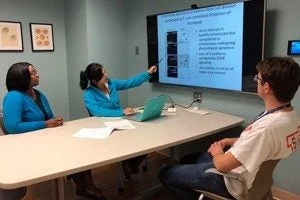
The Cell Biology program provides outstanding training of PhD candidates in a vibrant and rapidly evolving field. Our comprehensive program emphasizes original research, interdisciplinary coursework, and advanced topical colloquia. Trainees have the opportunity to explore fundamental questions in many areas including molecular mechanisms of cell function; regulation of growth and differentiation; cell interactions in migration; embryonic patterning in development; and morphogenesis of cells, tissues and organs. Training in cell and developmental biology forms the basis not only for making fundamental new discoveries, but also for understanding and exploring the links to human diseases where the fundamental processes of cytoskeletal dynamics, membrane trafficking, signal transduction, mitosis, cell adhesion, motility, mechanotransduction, and polarity go awry. For more information, click here…
Program Faculty
Molecular Biosensors; Spatiotemporal Regulation of Biological Signaling; Protein Engineering for Imaging, Diagnostics, and Therapeutics
Huiwang Ai
Molecular Biosensors; Spatiotemporal Regulation of Biological Signaling; Protein Engineering for Imaging, Diagnostics, and Therapeutics
Systems biology approaches to study gene dosage in neurodevelopment and neurodevelopmental disorders
Sameer Subhash Bajikar
Systems biology approaches to study gene dosage in neurodevelopment and neurodevelopmental disorders
1. Molecular and cellular therapy for tissue injury and repair, mainly focusing on heart and lung injury and repair. 2. Cancer biology, mainly focusing on identifying the molecular target that can inhibit the tumorigenesis during aging.
Chuanxi Cai, PhD
1. Molecular and cellular therapy for tissue injury and repair, mainly focusing on heart and lung injury and repair. 2. Cancer biology, mainly focusing on identifying the molecular target that can inhibit the tumorigenesis during aging.
Hematology and Oncology, Cell Biology, Lipid Signaling, Cancer Cell Signaling, and RNA Biology
Charles Edward Chalfant
Hematology and Oncology, Cell Biology, Lipid Signaling, Cancer Cell Signaling, and RNA Biology
Adult-born neurons, perineuronal nets, and microglia in hippocampal plasticity and behavior in health and disease
Elise Cope
Adult-born neurons, perineuronal nets, and microglia in hippocampal plasticity and behavior in health and disease
Neuron-glia and glial-glial interactions
Jaeda Coutinho-Budd
Neuron-glia and glial-glial interactions
Cell Adhesion and Adhesion-Dependent Cell Signaling in Vertebrate Morphogenesis
Douglas W. DeSimone, PH.D.
Cell Adhesion and Adhesion-Dependent Cell Signaling in Vertebrate Morphogenesis
Neural Development; Cell Division in Neural Stem Cells; Axon Outgrowth and Guidance
Noelle Dwyer
Neural Development; Cell Division in Neural Stem Cells; Axon Outgrowth and Guidance
Cytoskeletal architecture, dynamics and roles in cellular physiology and disease; High-resolution live cell and tissue imaging
Seham Ebrahim
Cytoskeletal architecture, dynamics and roles in cellular physiology and disease; High-resolution live cell and tissue imaging
Regeneration and Systemic Responses to Tissue Damage
Adrian J. Halme
Regeneration and Systemic Responses to Tissue Damage
Understanding Cellular and Molecular Mechanisms Leading to Blood Vessel Formation
Karen Kemper Hirschi
Understanding Cellular and Molecular Mechanisms Leading to Blood Vessel Formation
The Role of Mitochondrial Fusion and Fission in Tumorigenesis.
David F Kashatus
The Role of Mitochondrial Fusion and Fission in Tumorigenesis.
Cellular and molecular mechanisms of morphogenesis
Raymond E. Keller
Cellular and molecular mechanisms of morphogenesis
Architecture and function of biological membranes
Anne Kenworthy
Architecture and function of biological membranes
Regulation of Polarized Morphogenesis
Keith G. Kozminski
Regulation of Polarized Morphogenesis
The role of glia in the development, maintenance and regeneration of the nervous system
Sarah C Kucenas
The role of glia in the development, maintenance and regeneration of the nervous system
Precision medicine, translational science, regeneration, organoids, high resolution imaging, computational modeling
Saurabh Kulkarni
Precision medicine, translational science, regeneration, organoids, high resolution imaging, computational modeling
RNA regulatory networks and RNA binding proteins during cardiovascular development and in cardiovascular disease
Muge N Kuyumcu-Martinez
RNA regulatory networks and RNA binding proteins during cardiovascular development and in cardiovascular disease
Restoration of Homeostasis in Disease
Gordon W. Laurie
Restoration of Homeostasis in Disease
Cancer Biology, Tumor Cell of Origin and Tumor Microenvironment, Neurofibromatosis and Schwann Cell Biology, Skin and Hair Stem Cell Biology & Regeneration
Lu Q Le
Cancer Biology, Tumor Cell of Origin and Tumor Microenvironment, Neurofibromatosis and Schwann Cell Biology, Skin and Hair Stem Cell Biology & Regeneration
Composition, Biophysics and Physiology of Cellular Membranes
Ilya Levental
Composition, Biophysics and Physiology of Cellular Membranes
Wnt/PCP signaling in inner ear development Mouse models for human deafness Wnt/PCP signaling in neural tube closure
Xiaowei Lu
Wnt/PCP signaling in inner ear development Mouse models for human deafness Wnt/PCP signaling in neural tube closure
Genetic variation, Complex diseases, Coronary artery disease, Genomics, Epigenomics, Regulatory mechanisms, Vascular biology, Pharmacology and Physiology
Clint L. Miller
Genetic variation, Complex diseases, Coronary artery disease, Genomics, Epigenomics, Regulatory mechanisms, Vascular biology, Pharmacology and Physiology
Mitochondrial regulation of innate immune and antiviral signaling
Laura Elizabeth Newman
Mitochondrial regulation of innate immune and antiviral signaling
Investigating the cell-biological foundations of development
Ariel Pani
Investigating the cell-biological foundations of development
Developmental Genetics, Evolution and Regeneration
David Parichy
Developmental Genetics, Evolution and Regeneration
Mechanisms of tissue/organ homeostasis and tumorigeensis
Kwon Park
Mechanisms of tissue/organ homeostasis and tumorigeensis
Chromosome segregation and aneuploidy in meiosis and mitosis
Stefanie Redemann
Chromosome segregation and aneuploidy in meiosis and mitosis
Proteoform Systems Biology: proteogenomic approaches to uncover the role of proteomic variation in human disease
Gloria M. Sheynkman
Proteoform Systems Biology: proteogenomic approaches to uncover the role of proteomic variation in human disease
Regulation of neural stem cell proliferation during development and adulthood
Sarah Siegrist
Regulation of neural stem cell proliferation during development and adulthood
Spatial Cell Biology. Neuronal Morphogenesis and Disease. Cancer Migration and Invasion.
Elias T Spiliotis
Spatial Cell Biology. Neuronal Morphogenesis and Disease. Cancer Migration and Invasion.
Mechanisms of chromosome segregation in Mitosis and generation of Chromosomal Instability in tumors
P. Todd Stukenberg
Mechanisms of chromosome segregation in Mitosis and generation of Chromosomal Instability in tumors
Cell behavior and morphogenesis during early mouse development.
Ann E. Sutherland
Cell behavior and morphogenesis during early mouse development.
Regulation of cell-surface stability and intracellular trafficking of membrane proteins in epithelial cells
Agnieszka Swiatecka-Urban
Regulation of cell-surface stability and intracellular trafficking of membrane proteins in epithelial cells
Endosomal function and dysfunction in neurons. Development of the nervous system: cytoskeleton and membrane traffic in axon and dendrite growth.
Bettina Winckler
Endosomal function and dysfunction in neurons. Development of the nervous system: cytoskeleton and membrane traffic in axon and dendrite growth.
Investigating regeneration through genetics and single-cell analysis
Melanie I. Worley
Investigating regeneration through genetics and single-cell analysis
Regulation of Gene Expression, Development and Tumor Progression by TGF beta Signaling
David Wotton
Regulation of Gene Expression, Development and Tumor Progression by TGF beta Signaling
Cardiovascular Development and Cerebrovascular Pathologies
Joshua D Wythe
Cardiovascular Development and Cerebrovascular Pathologies
Mechanisms of Huntington's Disease Pathogenesis
Scott O. Zeitlin
Mechanisms of Huntington's Disease Pathogenesis
Genetics, Functional Genomics, Epigenetics, Lung repair/regeneration, Metabolic regulation, Alveolar stem cells, Chromatin interaction, Innate immune response, Live-cell imaging
Anny Xiaobo Zhou
Genetics, Functional Genomics, Epigenetics, Lung repair/regeneration, Metabolic regulation, Alveolar stem cells, Chromatin interaction, Innate immune response, Live-cell imaging