
Enrichment Program
Aims & Goals of the Enrichment Program
One of the main goals of this Pediatric Center of Excellence in Nephrology is to improve the understanding of kidney disease in children by promoting fundamental research efforts that will serve as the basis for new preventive, diagnostic and therapeutic strategies. Efforts towards the understanding of kidney disease are delayed by the need for more investigators in this research area and the lack of awareness of pediatric kidney research in the wider research community and the public. Our Educational Enrichment Program was established to address those issues and showed to be a key element in the Center.
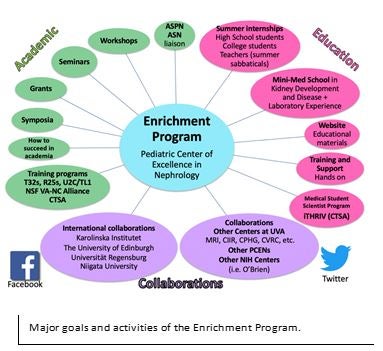
Overall Objective
Our overall objective is to address the following aims:
Aim 1. Inspire, attract and stimulate the interest of young individuals in Pediatric Nephrology research. It is our philosophy that inspiring and attracting new talent should start early. Thus, our plans encompass a broad swath of the educational continuum from high school, undergraduate and graduate students to postdoctoral fellows to junior faculty joining forces with other established programs (U2C/TL1, T32s, R25s, iTHRIV/CTSA and NSF VA-NC Alliance).
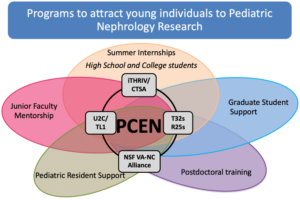
a. Provide research exposure to high school and college students. To develop the interest of young individuals to work in the field of Pediatric Nephrology, exposure to research in the field is important at an early stage. Upper-level high school and college students and first year medical students have been encouraged to work in the laboratories of investigators in the Center during the summer. Funds from the Center provide a stipend. Similarly, high school teachers who wish to participate in this endeavor are invited to perform hands-on research together with one of their students. This program initiated by the Provost several years ago has been extremely successful with numerous students having pursued careers in academia. We have implemented a program in collaboration with the College of Arts and Sciences (Department of Biology) whereby college students receive credit for an “independent research program” working directly with a qualified mentor.
b. Attract and retain the best graduate students to research in pediatric Nephrology. The investigators in this proposal have extensive experience in the training of graduate students. Institutional funds are used to support the best qualified graduate students to work in a project within the central theme of the PCEN and given the opportunity for exposure not only with investigators at UVA but also widely through our international and national collaborative arrangements and other PCENs. This enriches the educational experience of our students and simultaneously serves as a stimulus for them to join in our goal of understanding kidney development and disease in the benefit of children.
c. Stimulate the interest of pediatric residents and other trainees in Pediatric Nephrology. To develop the interest of Pediatric residents in Pediatric Nephrology, it is important that they be made aware of the research scope of Pediatric Nephrology. Accordingly, the Center will support one or two residents yearly to attend the meetings of The American Society of Pediatric Nephrology (ASPN) or the symposium sponsored by the ASPN during the meeting of The American Society of Nephrology. We will continue with our Research Seminar Series to expose and inspire residents by inviting renown researchers in the field (see the Educational Enrichment attachment). They will be also invited to an annual Center of Excellence Symposium in Pediatric Nephrology coordinated with the other 2 PCENs. Special consideration will be given based on research merit. Dr. Gomez is also a mentor for an NIH-funded short-term research training program (R25HL088724, PIs: Owens & Cross).
d. Attract and support junior faculty by providing them with protected time for research, mentorship, education and opportunities in an environment conducive to their success.
1. Junior faculty from UVA and other institutions not only receive one-on-one mentorship and P&F awards, but they also participate in all activities of the Center, including grant reviews and exposure to most of the strategic discussions with the view that they will acquire leadership skills that are best learned in a practical manner. As designed, the rich environment provided by the Center is a factory of innovation in education, research and public relations and we hope it will continue to be a magnet for the fostering of research in kidney diseases to benefit children. 2. How to succeed in academia today: In addition to direct mentoring by faculty and staff in the laboratories, we developed a formal program for career development which includes a wide range of topics from Training in the Responsible Conduct of Research, Methods for Enhancing Reproducibility, Ethics to balancing family life and academia, grant writing, lab management, mentoring, public speech, negotiating with your chair, etc. This program has been very well received by graduate students, postdocs and junior faculty alike. Overall, the main objectives of our training program include 1) Cultivating experimental competence and confidence in all trainees so that they become productive and independent investigators; 2) Developing vital research skills enabling trainees to perform and critically evaluate scientific research findings and conclusions, while also exposing them to the importance of reproducibility through rigor and transparency; and 3) Familiarizing trainees with cutting-edge scientific research tools and methodologies to be applied in kidney research, while fostering collaborative interactions through networking opportunities leading to team-oriented research approaches and the development of innovative strategies to solve experimental problems while investigating critical gaps in knowledge.
a. Make new technology available to scientists as rapidly as possible.
TTo speed the advance of research in Pediatric Nephrology, new technology, especially in the fields of epigenetics, lineage tracing and molecular biology methods must be readily available to scientists interested in developing new expertise in these areas. To achieve this goal, the laboratories of investigators in the Center will be open to any scientist who wishes to learn new methodologies. In conjunction with our yearly seminar in Pediatric Nephrology we will hold a hands-on workshop the day prior to the meeting. Participants will become acquainted with the technology available at our laboratories and will have the opportunity to initiate potential collaborations with Center members including our junior faculty and students. Students, residents and postdoctoral fellows actively participate through presentations and/or roundtables at our annual symposia and seminars in kidney development and disease. Information on all the educational activities, the research progress by the participating scientists, and public information is available on our website. The PCEN’s Single Cell Epigenomics, Transcriptomics and Bioinformatics Core, Histology Core, and Physiology Core are available to PCEN investigators, pilot project awardees, and the broader pediatric kidney research community at UVA and other institutions
b. Offer training in numerous procedures and techniques.
We provide hands-on training on 1) Microsurgical procedures in mice (i.e. acute central blood pressure measurement, ambulatory radio telemetry blood pressure, temperature and ECG recordings (with DSI units), partial and total unilateral ureteral obstruction and release in neonatal and adult mice, complete unilateral ureteral obstruction in adult mice, transplantation of embryonic organs under the kidney capsule, aortic coarctation, nephrectomy, kidney ischemia-reperfusion injury, bone marrow transplantation, etc…). 2) Cell differentiation and culture procedures, 3) Histology, 4) Mouse breeding strategies and phenotypical assessment, 5) Advice for experimental planning using molecular approaches (i.e. Cloning, CRISPR technology, Targeting design, Single Cell Genomics, and Epigenomics). We will also add training on innovative diagnostics for kidney disease such as Cationic ferritin enhanced-MRI (CFE-MRI) developed by Dr. Charlton at UVA and bubble contrast ultrasound (ce-RUS). These techniques allow precise measurements of glomerular number and flow.
c. Organize and sponsor a quarterly seminar at UVA on topics relevant to kidney development and disease. To expose established scientists and new investigators to important topics relevant to Pediatric Nephrology research, the PCEN organizes and sponsors quarterly seminars at UVA on topics relevant to kidney development and disease.
With the objective of cooperating on scientific matters and expanding the community of investigators in pediatric nephrology, the PCEN shares expertise, reagents, mouse models, and core services with researchers across the United States. Current national collaborations include:
- Northwestern University — Dr. Mazhar Adli, Ph.D.: CRISPR-based identification of chromatin-regulating protein complexes at the Ren1 gene locus (former PCEN Investigator). Dr. Gal Finer, M.D.: single-cell multiome analysis and experimental design for studies of Tcf21 in renin-lineage cells. Drs. Daniel Battle and Jan Wysocki: renin immunostaining analysis and experimental consultation.
- Medical College of Wisconsin — Dr. Curt Sigmund, Ph.D.: role of lamin A/C in blood pressure homeostasis. Dr. Pablo Nakagawa, Ph.D.: role of renin in the brain.
- Nationwide Children’s Hospital — consultation and analytical support for single-cell and spatial transcriptomics experimental design and data analysis (Pediatric Nephrology).
- The Scripps Research Institute — tissue processing, immunostaining, microscopy, and morphological analysis for kidney studies.
- Additional collaborators receiving mouse models, reagents, experimental design consultation, or core services include investigators at Duke University, Johns Hopkins University, Boston University, the University of Pittsburgh, University of Texas Southwestern, University of Washington, UC San Diego, UC San Francisco, Vanderbilt University, Washington University, Augusta University, and the University of South Florida.
The PCEN maintains active international collaborations with researchers in Europe and Asia. Current partnerships include:
- Erasmus University Rotterdam, Netherlands — Dr. Jan Danser, Ph.D. (Pharmacology): effects of renin-angiotensin system inhibition in hypertensive diabetic and non-diabetic rats; renin immunostaining and experimental consultation. Dr. Anton Roks, Ph.D. (Internal Medicine): the aging vasculature and kidney disease; histological analysis of kidney sections.
- Niigata University, Japan — Dr. Hirofumi Watanabe: generation of transgenic mouse models for renin baroreceptor studies. We continue to welcome opportunities for bilateral sabbaticals and collaborative visits to advance discovery in kidney development and disease.
Aim 4. Engage and educate the public and health professionals regarding recent advances in pediatric kidney research. Our educational activities reach out to the public. Our web site includes all relevant information about the Center’s activities written also in lay terms. We will further engage graduate students in the literature departments to help us expand a narrative that instructs and engages the public in the importance of kidney research in children.
The School of Medicine runs a program called “Mini-Med School” that brings an abridged version of medical school to approximately 120 community members each year. The program is open to high school students, UVA faculty and staff members, community members, and anyone else who would like to learn more about the medical profession. During the seven-week program UVA faculty members, with assistance from current medical students, lead the group in exploration of a wide range of topics in medical education. The participants visit our research laboratories for a 1h 30 min session where we highlight the research that is conducted in our PCEN. The program is extremely popular and always oversubscribed.
To educate other physicians as well as other care providers about renal diseases in children a one-day symposium will be held each year in this Pediatric Center of Excellence in Nephrology at the time of the Center Review Meetings. This will be organized using both departmental support from our institution and funds requested for the Center. Speakers will be drawn from basic and applied research areas relevant to kidney disease. The symposium will be advertised on the Center website, within the universities, through the ASPN, and to physicians and care providers in the area.