
Research
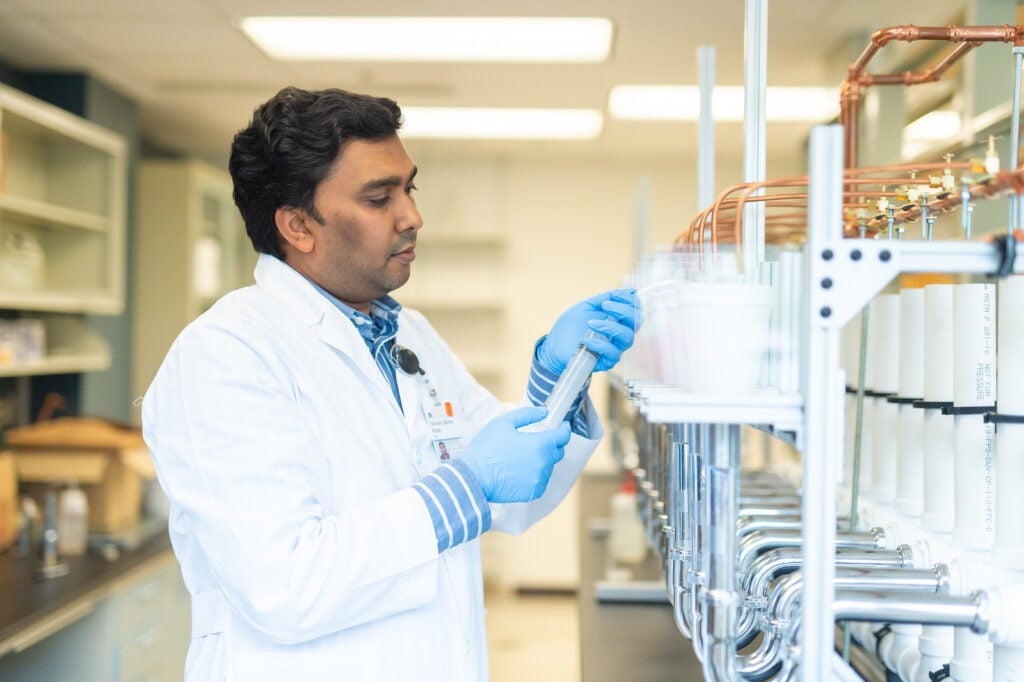 Research programs in UVA’s Division of Infectious Diseases & International Health and related disciplines are supported by more than $29 million in extramural funding. Faculty members conduct bench and clinical research of national and international significance, including the development of vaccines, diagnostic tools, and treatments for a variety of infectious diseases.
The division’s international and global research partnerships are one of its strengths. UVA faculty work collaboratively with university-based colleagues in many countries, with major partnerships at sites in Bangladesh, Brazil, Haiti, India, Pakistan, South Africa, Tanzania and Uganda.
To learn more about a specific ID faculty member’s research, go to the School of Medicine Research Faculty Directory and search by the individual’s last name.
Research Affinity Group in the Department or Affiliated Centers
Infectious Diseases
Interest Group: HIV and related syndemics
Focus: HIV, access to care and medications, health policy, social determinants of health; interested in expanding into HIV and (1) cardiovascular disease, (2) metabolic syndrome, and (3) aging
Meetings: ad hoc
Location: Zoom
Contact: Kate McManus (km8jr@uvahealth.org)
Center for Immunology Research
Interest Group: CIC Café (faculty only group)
Focus: invite people to do brainstorming around a topic, grant application feedback
Meetings: twice a month, first and third Tuesday (except special meetings), 3:00 – 4:00 PM
Location: MR6 Room 3526
Contact: Jie Sun (js6re@virginia.edu)
Our Division's Research Activities:
Interdisciplinary Research Opportunities:
Research in epidemiology and clinical infectious diseases is conducted at UVA’s hospital and medical center and at ID partner sites overseas, in areas that include antibiotic resistance (its spread and control), diagnostics, epidemiology of infectious diseases within both patient and general populations, and factors that influence disease susceptibility.
The following division faculty conduct research and instruct fellows in Clinical Infectious Diseases:

Heysell, Scott K.
Multidrug resistant tuberculosis (MDR-TB); pharmacokinetics; clinical application of diagnostics for TB; clinical trials to optimize TB treatment; chronic illness/ TB integration





Mathers, Amy J.
Molecular epidemiology of multidrug resistant gram negative bacilli, laboratory detection of gram negative antibiotic resistance, prevention of acquisition of resistant bacterial pathogens and treatment of multi-drug resistant gram negative bacteria.
Moore, Christopher C.
Sepsis pathophysiology with particular interest in the role of the innate immune system; sepsis pathophysiology, management, and outcomes of HIV infected patients in sub-Saharan Africa.

Sifri, Costi D.
Hospital epidemiology, immunocompromised infectious diseases, molecular pathogenesis and epidemiology, innate immunity

Taniuchi, Mami
Molecular diagnostics; Polio eradication; tracking immunity and virus shedding after oral polio vaccination in resource-challenged countries.

Warren, Cirle Alcantara
Prevention and treatment of C. difficile infection. Role of microbiota in health and disease. Infections in special populations- elderly, pregnant women and racial/ethnic minority groups.
International health research has long been a focus and strength of the division. Faculty not only work on pathogens of global concern, they do so in collaboration with overseas investigators and at partner study sites in Brazil, Bangladesh, Tanzania, Uganda and elsewhere. Many of these sites represent long-standing partnerships cultivated over years of grant-supported study.
Areas of investigation include diarrheal pathogens, malaria, diagnostics for Mycobacterium tuberculosis, the impact of childhood malnutrition, and the genetics of disease susceptibility.
The following interdisciplinary faculty conduct research and instruct fellows in this area:

Abhyankar, Mayuresh
Amebiasis vaccine development; biomarkers of Clostridium difficile disease severity


Guler, Jennifer
Mechanisms of Genetic and Metabolic Adaptation in the Malaria Parasite, Plasmodium falciparum
Heysell, Scott K.
Multidrug resistant tuberculosis (MDR-TB); pharmacokinetics; clinical application of diagnostics for TB; clinical trials to optimize TB treatment; chronic illness/ TB integration

Moore, Christopher C.
Sepsis pathophysiology with particular interest in the role of the innate immune system; sepsis pathophysiology, management, and outcomes of HIV infected patients in sub-Saharan Africa.
Taniuchi, Mami
Molecular diagnostics; Polio eradication; tracking immunity and virus shedding after oral polio vaccination in resource-challenged countries.
Microbial pathogens, host responses to infection, and pathogen manipulation of host cell biology are the focus of investigation for UVA faculty from a range of disciplines. Many are members of the Carter Immunology Center and the Myles H. Thaler Center for AIDS and Human Retrovirus Research.
The following interdisciplinary faculty conduct research and instruct fellows in this area:

Agaisse, Herve
Genetic approaches, cellular and molecular biology of intracellular pathogen infection

Casanova, James E.
Role of Arf family GTPases in vesicular transport and cytoskeleton assembly.
Cell Biology of bacterial pathogenesis.
The innate immune response to bacterial infection.





Sifri, Costi D.
Hospital epidemiology, immunocompromised infectious diseases, molecular pathogenesis and epidemiology, innate immunity
Warren, Cirle Alcantara
Prevention and treatment of C. difficile infection. Role of microbiota in health and disease. Infections in special populations- elderly, pregnant women and racial/ethnic minority groups.
Virology research at UVA utilizes a number of approaches, including immunology, cell biology, structural biology and cancer biology, to study viruses that include influenza, hepatitis C, Ebola, dengue, KSHV and HIV.
Much of the basic research in HIV is conducted at the Myles H. Thaler Center for AIDS and Human Retrovirus Research, a community of infectious disease and immunology experts that ranks among the best in the nation. Researchers address fundamental questions about how HIV replicates at the cellular and molecular level, and how AIDS develops.

Engel, Daniel A.
Drug Discovery and Molecular Biology of Pathogenic RNA viruses: Ebola, SARS-CoV-2, Influenza and Zika

Hammarskjold, Marie-Louise
Post Transcriptional Gene Regulation and the Molecular Biology of Human Retroviruses


Rekosh, David M.
Human Immunodeficiency Virus Gene Expression; Human Endogenous Viruses; SARS-CoV-2 Protein Trafficking; Post-transcriptional Gene Regulation