
Mohs Fellowship
The UVA Microscopic Surgery and Dermatologic Oncology fellowship is accredited by the Accreditation Council for Graduate Medical Education (ACGME) and approved by the American College of Mohs Microscopic Surgery and Cutaneous Oncology (ACMS). Successful completion of the fellowship qualifies you for membership in the ACMS in addition to accreditation by the ACGME that will be necessary for future board certification in Mohs Surgery. We train one fellow each year.
Two fellowship-trained Mohs surgeons are on the UVA Department of Dermatology faculty (all trained by different programs/directors). The faculty instruct the fellow in all aspects of Mohs micrographic surgery, including the indications, limitations, and applications of the procedure. The fellow will obtain experience in the repair of surgical defects resulting from Mohs surgery, with instruction provided in reconstructive dermatologic surgery, including skin flaps and grafts. In addition to Mohs surgery, the fellow will be instructed in the general principles involved in the management of various cutaneous neoplasms, both common and rare. Our fellowship also offers training in cosmetic and other dermatologic procedures, providing exposure to the principles of aesthetic repair and hands-on experience with a variety of cosmetic treatments, as desired. These include Botox, fillers, pulsed dye laser, and IPL. Our cosmetic dermatologist also serves as a faculty member for the fellowship. More in depth exposure to other cosmetic procedures can be arranged depending on the fellow’s interest.
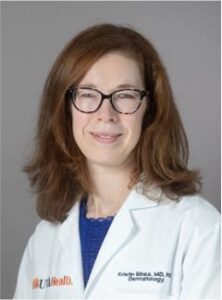
Kristin Bibee, MD, PhD
Program Director
Mohs Fellowship
There is one office – the UVA Mohs clinic.
Mohs surgery is performed daily, generally starting at 8:00 am depending on the clinic. Follow-up patients and new consults are seen during the late morning or early afternoon while additional Mohs layers are taken, and reconstructions are begun. Other minor surgeries are done in the afternoon. The primary focus of teaching is on Mohs surgery and reconstruction. The fellow will be exposed to all types of cutaneous tumors – predominantly basal and squamous cell carcinoma as well as melanoma- but also rarer malignancies such as atypical fibroxanthoma, dermatofibrosarcoma protuberans, Merkel cell carcinoma, extramammary Paget’s disease, and others.
The fellow’s training also includes extensive training in frozen section histopathology including appropriate laboratory techniques, mapping and processing of tissue specimens, the use of various stains including H&E and toluidine blue, as well as the actual preparation of frozen sections to be microscopically examined during Mohs surgery. The fellow will begin training by learning to cut and stain Mohs slides with proficiency, so when they finish their training, they can start and certify their own lab and teach their own laboratory technician. The fellowship training will qualify you to obtain a CLIA certificate for a high complexity laboratory. Our offices employ technicians who have been cutting Mohs sections for over 20 years. Typically, the fellow will interpret the frozen sections for each case and commit their interpretation on the Mohs map. This is followed by instruction by the attending at the microscope with the fellow reviewing the cases.
We have a strong relationship with the Departments of Plastic and Maxillofacial Surgery, Otolaryngology, Pathology, Radiation Oncology and Ophthalmology. There is an emphasis on using a multidisciplinary approach in the management of difficult cutaneous neoplasms, including appropriate staging and adjuvant care.
Application and Selection Process
Interested applicants for 2027 start and beyond should apply online at www.sfmatch.org.
Applications are reviewed holistically by a faculty-based selection committee, with consideration given to clinical performance, letters of recommendation, scholarly activity, and demonstrated interest in Mohs surgery and procedural dermatology. Selected applicants will be invited for interviews, which provide an opportunity to learn more about the fellowship curriculum, faculty mentorship, and clinical environment. Final selection decisions are made following interviews and in accordance with institutional and national fellowship guidelines.
Important Dates
- Submit your SF Match application file with LORs or CV, letter of interest, and LORs to Abby Mayer xfp6kb@uvahealth.org prior to February 16, 2026, at 5 PM EST
- Applicants will be notified of their status by February 28, 2026
- Virtual interviews will happen on March 5 & 6, 2026
- Fellowship will start on August 1, 2026
- Away Rotations (observership only) between September – October 2026
Research/Scholarly activity
The fellow is an integral part of our clinical and translational research group and is expected to complete an in-depth research project by the time they finish the fellowship and to prepare a manuscript suitable for submission to a peer-review journal as well as mentor residents and medical students in cutaneous oncology relevant research. Additional research is encouraged. The fellow is expected to present a lecture to the dermatology residents at least once a year on a dermatologic surgery topic. The fellow is expected to submit an abstract for a national or state meeting prior to the completion of their training.
Teaching/Mentoring
Regular interaction with patients under the guidance and supervision of faculty members who give value, context, and meaning to those interactions. Fellows assume graded and progressive responsibility in patient care, according to demonstrated knowledge, skills, and competencies.
Formal education to set up and operate a Mohs frozen section laboratory, as well as nearly daily interactions that provide education in the supervision and training of histotechnicians.
Regular opportunities to teach rotating residents and medical students and dermatologic surgery support staff.
Evaluation
An evaluation process helps the fellow to assess his or her skills and to identify areas for improvement as early as possible. Supervising faculty routinely provide the fellow with informal feedback based on immediate observation of the fellow’s performance. Fellows also benefit from regularly scheduled, documented formal evaluations, which they can access for review.
Our Team
faculty member’s training program and fellowship director (their training program)
Program Director
Kristin Bibee, MD, PhD – Mohs Surgery (University of Pittsburgh)
Core Faculty
Mark Russell, MD – Mohs Surgery (Vanderbilt University)
Alexandra Hickman, MD – Cosmetic Dermatology (Barnes-Jewish Hospital at Washington University, St. Louis)
Samuel Oyer, MD – ENT – FP (Medical University of South Carolina)
Program Coordinator
Abby Mayer xfp6kb@uvahealth.org
Benefits, Compensation, & Prerequisites for Employment at University of Virginia
An overview of salary, benefits and employment eligibility is available under https://med.virginia.edu/gme/program-resources/salary-benefits/
Away Rotations
Following a careful review of your application, selected applicants will be asked to review the GME policy on away rotations and proceed with completing the application.
Eligibility for Fellowship Training
Qualified applicants will have completed a dermatology residency program which meets ACGME requirements by the specified start date. Board eligibility in dermatology is required at the beginning of the fellowship. ACGME Program Requirements
For additional information, please email the program coordinator Abby Mayer at xfp6kb@uvahealth.org