
Nuclear Radiology
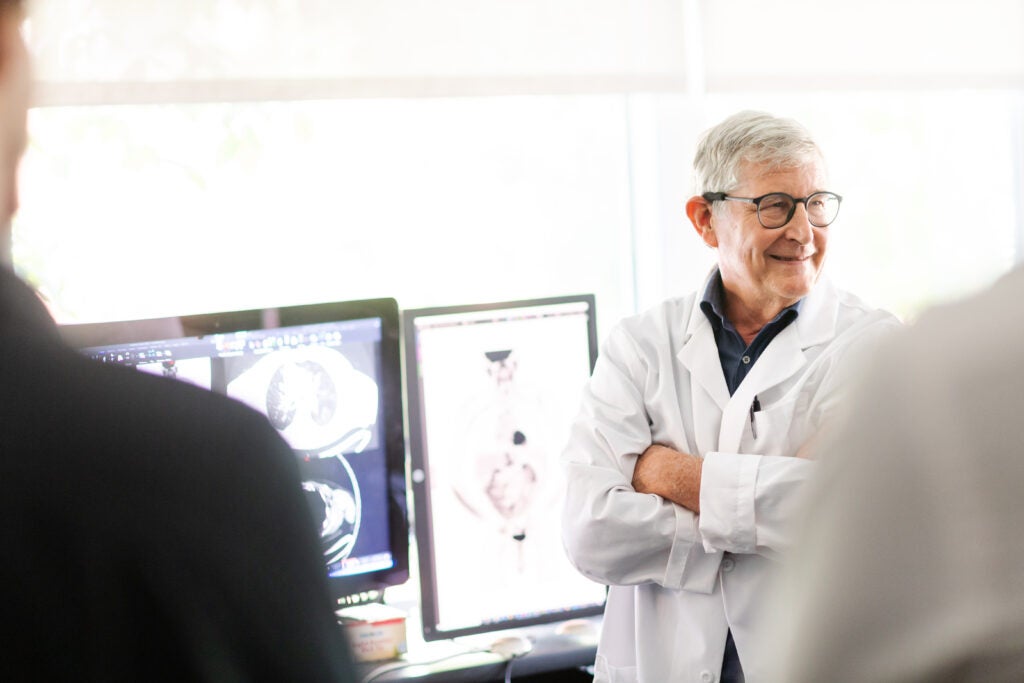
The Division of Nuclear Medicine at the University of Virginia School of Medicine is housed in the Emily Couric Clinical Cancer Center and is an SNMMI-designated Radiopharmaceutical Therapy Center of Excellence. The division, functioning under the Department of Radiology and Medical Imaging, offers an ACGME-accredited one-year fellowship in Nuclear Radiology to candidates who have completed a residency in diagnostic radiology at an ACGME-accredited institution or in an RCPSC-accredited or CFPC-accredited residency program located in Canada. Candidates must have the ability to obtain a license to practice medicine in Virginia. Those wanting to begin a fellowship immediately following the completion of their residency should apply in the late fall/early winter of their third year of radiology residency. Our program is accredited to accept one fellow per year.
The Division of Nuclear Medicine provides full range of diagnostic and therapeutic services using radioisotopes. Usual procedures include studies such as radionuclide imaging and functional studies of the bone, heart, kidney, lung, hepatobiliary system, thyroid, parathyroid and infection. Dedicated tumor imaging such as MIBG, Octreoscan, MIBI, and I-131 are also performed. Studies of the gastrointestinal tract include quantitative gastric and esophageal emptying studies, and scans for Meckel’s diverticulum or gastrointestinal bleeding. Brain imaging includes brain death scan, cisternograms, cerebrospinal fluid flow and shunt studies, and planar and SPECT/CT scans of cerebral blood flow for epilepsy and neurodegenerative diseases.
PET/CT scanner is available for all approved clinical indications, including oncologic, neurologic, and cardiac. 18F-FDG, 18F-DOTATATE, 18F-PSMA, 18F-FES, 18F-Florbetapir, 18F-Flurpiridaz PET/CT studies are routinely performed at our institution.
Therapeutic procedures include treatment of thyrotoxicosis and thyroid cancer with radioactive iodine, prostate cancer with Radium chloride and 177Lu-PSMA, and neuroendocrine cancer with 177Lu-DOTATATE.
The division also provides opportunities for research work for interested trainees with travel allotment for presenting at national meetings.
The specific goals include objectives required for every level and focused area of training, with graduated levels of supervision and responsibility. All aspects of nuclear medicine imaging and therapy are incorporated into the fellowship, including nuclear cardiology. During the training year, the fellow will read the required material and study the teaching files in nuclear medicine. Over time, the fellow will be expected to gain adequate knowledge about normal scintigraphic anatomy and physiology and about the scintigraphic appearance of disease processes. The program provides an enriched exposure to nuclear oncology including theranostics and nuclear cardiology, with a structured training that provides the base for Board preparation (ABR Special Competency in Nuclear Radiology) and the clinical and academic practice of Nuclear Radiology.
During the Nuclear Medicine Fellowship, the fellow is expected to:
- Develop a complete understanding of the fundamentals of radiation physics, radiation biology, and radiation protection as they relate to Nuclear Radiology
- Gain competence in interpreting dynamic and static nuclear imaging (planar, SPECT, SPECT-CT and PET-CT) of physiologic and pathophysiologic processes including normal anatomy and biodistribution
- Gain competence in the utilization and handling of radiopharmaceuticals, and quality control of nuclear imaging instruments and radiopharmaceuticals
- Learn to perform and skillfully implement the clinical and technical aspects of Nuclear Radiology procedures to maximize their safe utilization
- Learn how to function as an NRC Authorized User of radioisotopes for diagnostic use and for therapies involving administered doses <33 mCi I-131, administered doses >33 mCi I-131, and parenteral alpha and beta therapies, and maintain records of the same
- Establish a firm foundation of clinical knowledge and technical expertise upon which to base further personal development in the field of Nuclear Radiology
- Develop familiarity with the signs and symptoms of disease entities amenable to the diagnosis with Nuclear Radiology, and complementary role of other imaging modalities
- Protocol nuclear radiology studies on a daily basis and guide referring physicians and nuclear medicine technologists to order and perform appropriate respectively
- Clear nuclear medicine exams when required before discharging patients from nuclear medicine suite
- Participate in and run tumor boards on a weekly basis
- Participate in journal clubs, resident lectures, and case conferences
- Participate in nuclear medicine QA/QC conferences
- Participate in therapy consults and generate consult notes in the electronic medical records
- During the rotation, read the required material and study the teaching file in nuclear medicine
- Develop an understanding of common research methods and study design as well as common pitfalls to clinical research, with emphasis on application to Nuclear Radiology
- Serve as a learning resource for medical students, residents, and ancillary medical staff and become actively involved with teaching of residents
- Develop the habit of routinely surveying the medical literature and using this knowledge in patient care; this should be done before any type of procedure or with any clinical presentation with which the fellow is not completely familiar
- Develop a bedside and clinic manner that meets the needs of patients and provides a thorough patient assessment
- Demonstrate a knowledge of and attitude for ethical practice
- Have consistently professional behavior and good communication skills
- The fellow will know how to supervise and perform radionuclide image-guided procedures at the completion of their fellowship
- Ensure compliance with ACGME requirements for the fellowship
Call
Following a transitional period in which graded responsibility is transferred to the fellow, the fellow is assigned to weekend call (Friday night through Monday morning) on a rotating basis with a frequency no greater than every 3rd weekend. The fellow serves as a back-up from home to radiology residents working in the hospital that are available to cover all emergency or after-hours cases, with final back-up by a Nuclear Radiology attending.
Nuclear Medicine Fellowship Curriculum
The Nuclear Radiology Core Curriculum (revised June 2025) is designed to provide the Nuclear Radiology fellow with a foundation for developing advanced expertise in clinical nuclear radiology including cardiac nuclear medicine and radionuclide therapy. The structured training provides the base for preparation for certification in Nuclear Radiology by the American Board of Radiology and for the clinical or academic practice of nuclear radiology, including eligibility for Authorized User status by the Nuclear Regulatory Commission or State (if the fellow practices in an agreement state).
General Goals: The specific goals include objectives required for every level and focused area of training, with graduated levels of supervision and responsibility. All aspects of nuclear medicine imaging and therapy are incorporated into the fellowship training including cardiac nuclear medicine and radionuclide therapy. During the training, the fellow will read the required material from the provided electronic textbooks, compiled review articles and teaching files stored in a shared drive. Over time, the fellow will be expected to build an understanding of scintigraphy exams including radiotracers involved, biodistribution, expected normal findings and common abnormalities. Fellows will gain competence in interpreting dynamic and static nuclear imaging (planar, SPECT, SPECT/CT and PET-CT). Fellows will gain competence in the utilization and handling of radiopharmaceuticals for diagnostic and therapeutic purposes and quality control of nuclear imaging instruments and radiopharmaceuticals. In addition, the fellow will increasingly understand disease entities, their clinical presentations, and current modes of treatment.
The fellow will know how to function as an NRC Authorized User of radioisotopes for diagnostic use and for therapies involving administered doses <33 mCi I-131, administered doses >33 mCi I-131, and parenteral administration of any beta emitter, or a photon-emitting radionuclide with a photon energy less than 150 keV, for which a written directive is required, and/or parenteral administration of any other radionuclide, for which a written directive is required. Teaching and consultation skills will be practiced and honed during the fellowship.
The structured training provides the base for preparation for certification by the ABR and for the clinical and academic practice of Nuclear Radiology.
Note: Currently ABR has discontinued including Authorized User- Eligible (AU-E) on ABR certificates (https://www.theabr.org/diagnostic-radiology/initial-certification/nrc-compliance). Candidates who are interested in AU eligibility are encouraged to discuss with the program directors at the start of the fellowship and should refer to the attached link for the requirements.
AU-eligibility for DR and IR/DR residents and those in alternate pathway:
- Administering to patients or human research subjects’ dosages that include at least 3 cases involving the oral administration of ≤ 33 mCi and at least 3 cases involving the administration of > 33 mCi of sodium iodide 131I.
AU-eligibility for Nuc Rad special competency:
- Administering to patients or human research subjects’ dosages that include at least 10 cases involving the oral administration of ≤ 33 mCi and 5 cases involving the administration of > 33 mCi of sodium iodide 131I.
- Administering to patients or human research subjects’ dosages that include at least 5 cases involving the parenteral administration of any beta emitter, or a photon-emitting radionuclide with a photon energy less than 150 keV, for which a written directive is required, and/or parenteral administration of any other radionuclide, for which a written directive is required.
ABR Sub-specialty certification eligibility:
Candidates who are interested in subspecialty certification in Nuclear Radiology are encouraged use this link. https://www.theabr.org/diagnostic-radiology/subspecialties/nuclear-radiology/requirements-registration.
In general, US trained radiology residents can become eligible for subspecialty certification after successful completion of 1-year ACGME fellowship. Candidates who are foreign-medical graduates and who undergo ACGME Nuclear Medicine fellowship as part of their ABR alternate pathway for radiology certification can attain subspecialty certification through alternate pathway (https://www.theabr.org/diagnostic-radiology/subspecialties/nuclear-radiology/alternate-pathway).
Fellowship supervision in Nuclear Radiology is a combination of consultative and direct supervision with graded increases in responsibility. Our general philosophy is that in order to provide high quality clinical service and excellent fellowship teaching, close fellowship supervision is important with progressively increased responsibility as the fellow gains experience. Fellow evaluations of performance are maintained by the Fellowship Coordinator.
Fellows are provided with written evaluation of their performance four times during the program. The faculty performs evaluations of the fellows’ performance at 3, 6, 9, and 12 months.
Anonymous evaluations by the fellows of the program are completed annually, and faculty are anonymously evaluated quarterly. Faculty are evaluated using a numerical scoring system on a wide variety of clinical, teaching, and research skills.
Our fellows receive an annual salary that is competitive with compensation offered by other institutions. They receive medical and dental care benefits for themselves and their immediate family. Additionally, malpractice insurance is provided at no charge.
Our fellows receive an annual stipend. This stipend is to cover expenses related to attending meetings or buying books. Each fellow is encouraged to attend one educational meeting of his/her choice.
Vacation and Leave Policy
Fellows have 15 business days of vacation time. Additional time off is granted for fellows presenting at national Radiology meetings.
Office Space
Fellows have combined office space with several cubicles, separate computers, telephones, and PACS.
For an updated list of division and departmental faculty, click here.
Radiology residents who desire to begin a fellowship immediately following the completion of their residency should apply in the late fall/early winter of their 3rd year of radiology residency. Fellows are selected on the basis of their medical training, general and academic achievements, and personal qualities. International medical graduates are welcome to apply. A personal interview is required unless there are exceptional circumstances.
As a non-match fellowship, our program complies with the timeline established by the Society of Chairs of Academic Radiology Departments (SCARD). Our program cannot accept applications or offer an opportunity to interview until November 1, 2026.
Exceptions to the SCARD embargo include:
- Applicants whose spouse/domestic partner is also applying for a medical fellowship in the same year
- Internal candidates
- Military candidates
- International candidates – international candidates are defined as applicants from programs that are neither ACGME or RCPS programs (i.e., Canadian applicants are NOT excluded from the embargo.)
Interviews may begin January 11, 2027 and will end March 31, 2027. A personal interview is required for all applicants. Interviews will be conducted virtually for this cycle upon the recommendation of SCARD.
Acceptance into the program will be on a rolling basis. Per SCARD guidelines, noon eastern standard time on January 25, 2027 is the first day offers may be made. Applicants have until noon eastern standard time January 27, 2027 to accept or decline any offer made before January 27. For any offer made on or after January 27, the candidate has a one-day grace period (noon eastern standard time) to accept or decline the offer.
Applicants will need to send the following, via email, to the program administrator Alison Peterson at alr6r@uvahealth.org:
- Curriculum Vitae (CV)
- Personal statement or letter of interest summarizing your training background, areas of particular strength and interest, and describing how you would hope to utilize and apply your medical training
- Three current letters of recommendation, including one from your radiology residency program director; letters should come from those persons who are familiar with your recent training and current professional activities. Letters of recommendation may be sent via email, however, this must come from the account of the author or his/her designee (program coordinator, administrative assistant).
- USMLE Step 1, 2, and 3 scores (transcript preferable)
- ECFMG certification (if applicable)
For Residency and Fellowship Applicants Requiring Visa Sponsorship
Institutionally, we sponsor the J1 clinical visa. Decisions about sponsorship of other visa types are made at the department level. All graduates of international medical schools must hold a valid certificate issued by the Educational Commission for Foreign Medical Graduates (ECFMG) to be appointed as a resident or fellow following the Accreditation Council for Graduate Medical Education.
Contact
Jiefu Zheng, MD
Program Director, Nuclear Radiology Fellowship
she2pu@uvahealth.org
434-924-9333
Prem P. Batchala, MD
Associate Program Director, Nuclear Radiology Fellowship
ppb2f@uvahealth.org
Alison Peterson
Education Program Administrator
alr6r@uvahealth.org
434-243-9363
Verifications (view more info here)
radeducation@uvahealth.org
Address
For US Postal service delivery:
University of Virginia School of Medicine
Department of Radiology and Medical Imaging
Box 800170
Charlottesville, VA 22908
Physical address (for all other forms of delivery):
University of Virginia School of Medicine
Department of Radiology and Medical Imaging
1215 Lee Street
Charlottesville, VA 22908
The Nuclear Medicine Fellowship Program at the University of Virginia is accredited by the Accreditation Council for Graduate Medical Education (ACGME).
The University of Virginia School of Medicine is accredited by The Liaison Committee on Medical Education (LCME). The University of Virginia is an Equal Opportunity employer.